
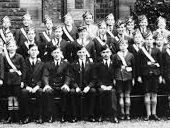
The Boys’ Brigade (BB) is an international interdenominational Christian youth organisation, conceived by the Scottish businessman Sir William Alexander Smith to combine drill and fun activities with Christian values. Following its inception in Glasgow in 1883, the BB quickly spread across the United Kingdom, becoming a worldwide organisation by the early 1890s. As of 2018, the Boys’ Brigade claimed 750,000 members in 60 countries.
The BB inspired the formation of other similar brigade organisations serving particular denominations, regions, genders, ideals, other religions, or even individual churches, such as the Church Lads’ Brigade (1891), London Diocesan Lads’ Brigade and Church Girls’ Brigade (all Church of England and later amalgamated into the Church Lads’ and Church Girls’ Brigade), the pacifist Boys’ Life Brigade (formed 1899 by the National Sunday School Union with strongest support amongst non-conformist churches), the Girls’ Brigade, the Girls’ Life Brigade, Bolton Boys’ Brigade, Catholic Boys’ Brigade (1894), Baptist Boys’ Brigade, and the Jewish Lads’ Brigade (1895), inspiring a whole brigade movement.
Object, motto and emblem

The object of the Boys Brigade is “the advancement of Christ’s kingdom among Boys and the promotion of habits of obedience, reverence, discipline, self-respect, and all that tends towards a true Christian manliness.” Except for the addition of the word “obedience” in 1893, the contents of the object have remained unchanged from the beginning. However, some countries, particularly those that permit girls on their membership rolls, have reworded the object for gender neutrality. For example, in Malaysia, the word “manliness” has been changed to “character”.
When designing the Brigade’s motto and crest, William Smith referred directly to Hebrews 6:19 in the King James Version of the Bible, “Which hope we have as an anchor of the soul, both sure and stedfast…”.
From this verse came the BB motto “Sure and Stedfast,” retaining the old spelling of the latter word. Today, some parts of the movement (only the UK and the Republic of Ireland) have adopted the modern spelling of “steadfast,” while all others continue to use the older spelling.
The crest was originally a plain anchor, bearing the BB motto with a capital ‘B’ on either side. Upon the merger between the Boys’ Brigade and the Boys’ Life Brigade in 1926, the red Greek cross was placed behind the anchor to form the current emblem. The cross originally formed part of the emblem of the Boys’ Life Brigade.

BB Vesper
The BB Vesper is a prayer sung after every BB meeting. Every BB Boy and officer is expected to know how to sing it.
Lyrics:
Great God who knowest all our need
Bless Thou our watch and guard our sleep.
Forgive our sins of thoughts and deed,
And in Thy peace Thy servants keep.
We thank Thee for the day that’s done,
We trust Thee for the days to be.
Thy love we learn in Christ Thy Son,
O may we all His glory see.
Amen.
History
.jpg)
The Boys’ Brigade was founded in Glasgow by Sir William Alexander Smith on 4 October 1883 to develop Christian manliness by the use of a semi-military discipline and order, gymnastics, summer camps, and religious services and classes.
By 1910, there were about 2200 companies connected with different churches throughout the British Empire and the United States, with 10,000 officers and 100,000 boys.[7]
Boys’ Brigade Scouts, 1906–1927
Companies of The Boys’ Brigade used manuals on scout training in their programmes. In May 1903, Robert Baden-Powell became a vice president. Baden-Powell promoted the idea of scouting and outdoor pursuits in the Boys’ Brigade and other boys’ organisations and schools.[9] The Boys’ Brigade formally began its boy scout scheme in 1906. Scout badges (Silver second class & Gold first class) were awarded in The Boys’ Brigade, and there were specialised Boys’ Brigade Scout sections, which operated as part of a BB Company but met at different times to train in scouting, who wore khaki or blue uniforms, neck scarves, and the distinctive four-dented broad-brimmed fur felt hats. Boys of the Bournemouth & Poole Battalion of The Boys’ Brigade participated in Baden-Powell’s experimental camp on Brownsea Island in 1907. Baden-Powell did not originally intend to start a separate organisation.
Many Boys’ Brigade Scouts later made dual registration with The Boy Scouts Association. The 1st Bournemouth Scouts were run by the 1st Bournemouth Boys’ Brigade as a ‘BP’ Scout group and never a ‘BB Scout ‘Section’. The Boys’ Life Brigade, which merged with The Boys’ Brigade in 1926, also operated its own boy scouts and was a member organisation of the National Peace Scouts with the British Boy Scouts. The Boys’ Brigade Scouts continued until 1927. Some former Boys’ Brigade Scout units continued independently after 1927 or were affiliated with The Boy Scouts’ Association or British Boy Scouts. Two of the original Boys’ Brigade Scout units continue as 1st Parkstone Scout Group and 1st Hamworthy Scout Group, both formerly subunits of the 1st Poole Boys Brigade.
Merger with Boys’ Life Brigade, 1926
In October 1926, The BB united with The Boys’ Life Brigade. The Boys’ Life Brigade had been formed in 1899, as a pacifist alternative to the BB by the National Sunday School Union and was strongest amongst non-conformist churches. It substituted the first aid drill for the military and the weapons drill used in the BB. The merger prompted the abandonment of weapons and dummy drill rifles that had been used in the BB, due to the Life Brigade’s objections to the use of weapons or their representations. The BB anchor badge was altered to include a red cross of the Boys’ Life Brigade. Prior to the amalgamation in 1926, the junior organisation of the BB was called ‘The Boy Reserves’ but after amalgamation the juniors were called ‘The Life Boys’. The name came from the fact that the junior reserve of The Boys’ Life Brigade had been known as ‘Lifeboys’ (all one word). The Life Boys remained as the ‘Junior Reserve of the BB until 1966, when the name was changed to ‘The Junior Section’.
Establishment of recreational camping
Drawing from his military experience, William Smith (Knighted in 1909) introduced the concept of camping into the Brigade to allow boys and officers to remain in contact when other activities ceased for the summer break.
The notion was initially ill-received due to concerns for the boys’ safety. A mother has been quoted saying, “Camp! My children have always had a roof over their heads, and as long as I live, always will!”. They did have a roof over their heads because William Smith proceeded with the idea, and 1st Glasgow Company held its inaugural one-week camp beginning on Friday, 16 July 1886, at Auchinlochan Hall, Tighnabruaich in a hall. In later years, they took to canvas camping on a site at Portavadie in the Kyles of Bute. The First Glasgow continued to attend summer camp at the same location until the summer of 1974, when Portavadie was selected as the location of a proposed yard for the construction of oil production platforms. However, the new camp is located only 100 yards away at Stilliag Farm. This camp site is now used by many companies of the BB every summer for their camping trip.
The initial reservations towards camping did not last. A tradition developed where the boys who were marching home on the last day of camp would be greeted by cheers from residents and were each presented with a bouquet of flowers. Camps soon became one of the most anticipated events of the year, and early publications of the Boys’ Brigade Gazette contained many accounts of camping experiences.
Sir William Smith’s plans and notes for his first camps have been preserved and have been used by many other campers.
Leave a Reply